Load-Bearing Couch Cushions: Inside the Great American Blanket Fort Boom
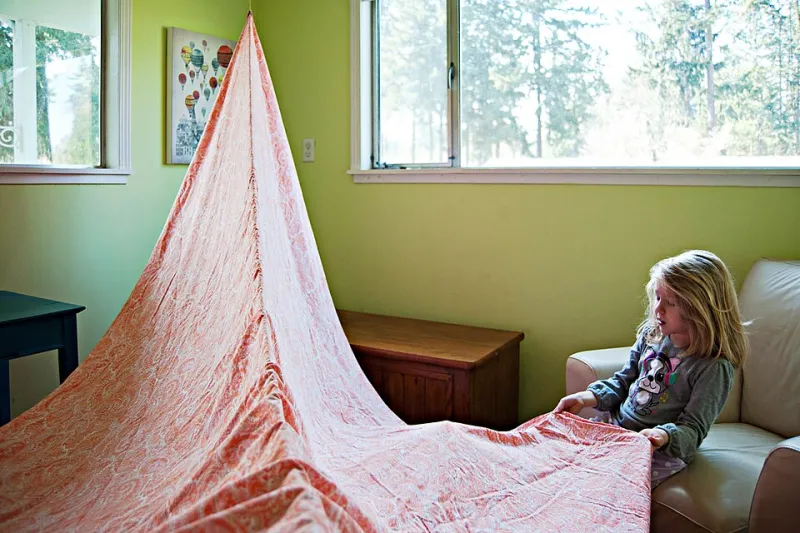
Photo: Personal Creations, CC BY 2.0, via Wikimedia Commons
Somewhere in America right now, a six-year-old is staring down a structural engineering problem that would make an actual architect sweat. Two dining chairs, one fitted sheet with questionable elastic, and a load-bearing couch cushion that keeps betraying the whole operation. This is the blanket fort — and it's not just play. It's physics, design, negotiation, and imagination wearing a sleeping bag.
Welcome to the great fort renaissance. Rainy afternoons are back. Screens are getting (temporarily) ignored. And the humble living room has become America's most innovative construction site.
Why Forts Are Secretly Genius
Ask a child psychologist about fort play and watch them light up. Building a fort hits a remarkable number of developmental targets at once:
- Spatial reasoning: Kids instinctively learn about weight distribution, tension, and support. That sheet won't stay up without a peak point — congratulations, you've discovered the basic principle of the tent pole.
- Executive function: Forts require planning, revision, and frustration tolerance. When the roof collapses for the fourth time, your kid is learning persistence, one clothespin at a time.
- A sense of control: Here's the deep one. Forts are small, enclosed spaces that kids design and govern themselves. In a world where adults run everything, a fort is a tiny sovereign nation with a kid for a president. Experts suggest this kind of self-directed space genuinely helps children process big feelings and recharge.
- Cooperation: Almost no fort gets built solo. There's a designated sheet-holder, a cushion-hauler, a boss (there's always a boss).
In other words: the fort your kids build this Saturday is doing more educational heavy lifting than a workbook ever could. Don't tell them.
Structural Tips From Parents Who've Been There
We talked to plenty of fort veterans (read: parents with strong opinions and sagging living room ceilings), and the same wisdom keeps surfacing:
1. Build around a table. The kitchen or dining table is your cathedral — a rigid frame with built-in height. Everything else is scaffolding.
2. Respect the cushion. Couch cushions are your bricks: heavy, flat, stackable. Use them as anchors and walls, never as roof. Roofs need fabric. Fabric is light. This is the whole game.
3. Tension is your friend. A saggy roof reads as failure. Pull that sheet taut between two anchor points — chair backs, doorknobs, radiator (cold radiator) — and suddenly you've got architecture.
4. Clothespins are the secret weapon. Tape tears the sheets and loses grip. Clothespins clip fabric to furniture, fabric to fabric, dreams to reality. A bag of 50 costs about five dollars and will change your fort game forever.
5. Leave a door. Every fort needs an entrance and an escape hatch. Ask any kid. It's non-negotiable.
Three Themed Builds Worth the Effort
Once the basic structure stands, the real fun begins. A fort is just a room until you give it a job:
The Reading Nook. String up fairy lights (battery-powered, please), pile in every pillow you own, and stock a basket of books within arm's reach. Kids who claim they "hate reading" have been known to disappear into a fort with a stack of Dog Man for two hours. The fort does the persuading.
The Backyard Movie Theater. Drape a white sheet as the screen wall, set up a tablet or mini projector, pop the corn, and hand out tickets — construction paper, obviously. Concession stand run by the youngest. Prices negotiable, quality questionable, experience unforgettable.
The Indoor Camping Expedition. Sleeping bags, flashlights, a battery lantern, and — if you're brave — s'mores assembled on graham crackers without the fire (microwave, ten seconds, trust us). Tell spooky stories at an age-appropriate spook level. Fall asleep inside. Wake up still inside the fort, which is a feeling no hotel can replicate.
The Blueprint: Fort of the Year
Ready to go all in? Here's the one-rainy-afternoon flagship build. Total time: about 45 minutes. Crew: two kids and one grown-up (for the high stuff).
Materials: 1 large sheet or lightweight blanket for the roof, 2–3 smaller blankets for walls, 6–8 couch cushions, 4 dining chairs, 1 clothespin bag, fairy lights, pillows, snacks.
Step 1: Push the couch until its back faces the room. This is your rear wall.
Step 2: Place two dining chairs about five feet in front of the couch, seat-to-seat, roughly four feet apart.
Step 3: Drape the big sheet over the chair backs and couch back, creating a peaked roofline. Clip it tight with clothespins. Ta-da: a ceiling that doesn't sag.
Step 4: Use the remaining chairs and stacked cushions to form side walls, draping the lighter blankets between them. Clip everything. Then clip more things.
Step 5: Build the entrance — two cushions leaned together in an A-frame at the front, leaving a kid-sized gap.
Step 6: Interior design phase. Fairy lights along the roofline. Pillows on the floor. A snack station in the corner. A sign on the door that says something like "NO GROWNUPS (EXCEPT MOM) (AND DAD FOR SNACKS)."
Step 7: Get inside. All the way inside. This is the most important step and the most frequently skipped by adults.
The Only Rule
Every fort eventually comes down. The chairs go back, the cushions return to the couch, and the living room returns to its boring, upright configuration. But here's the thing about the blanket fort: the point was never the structure.
The point was the afternoon.
So the next rainy Saturday, skip the screen-time standoff. Grab the sheets. The cushions are load-bearing, the clothespins are standing by, and the coziest room in America is about to be built by its smallest engineers.